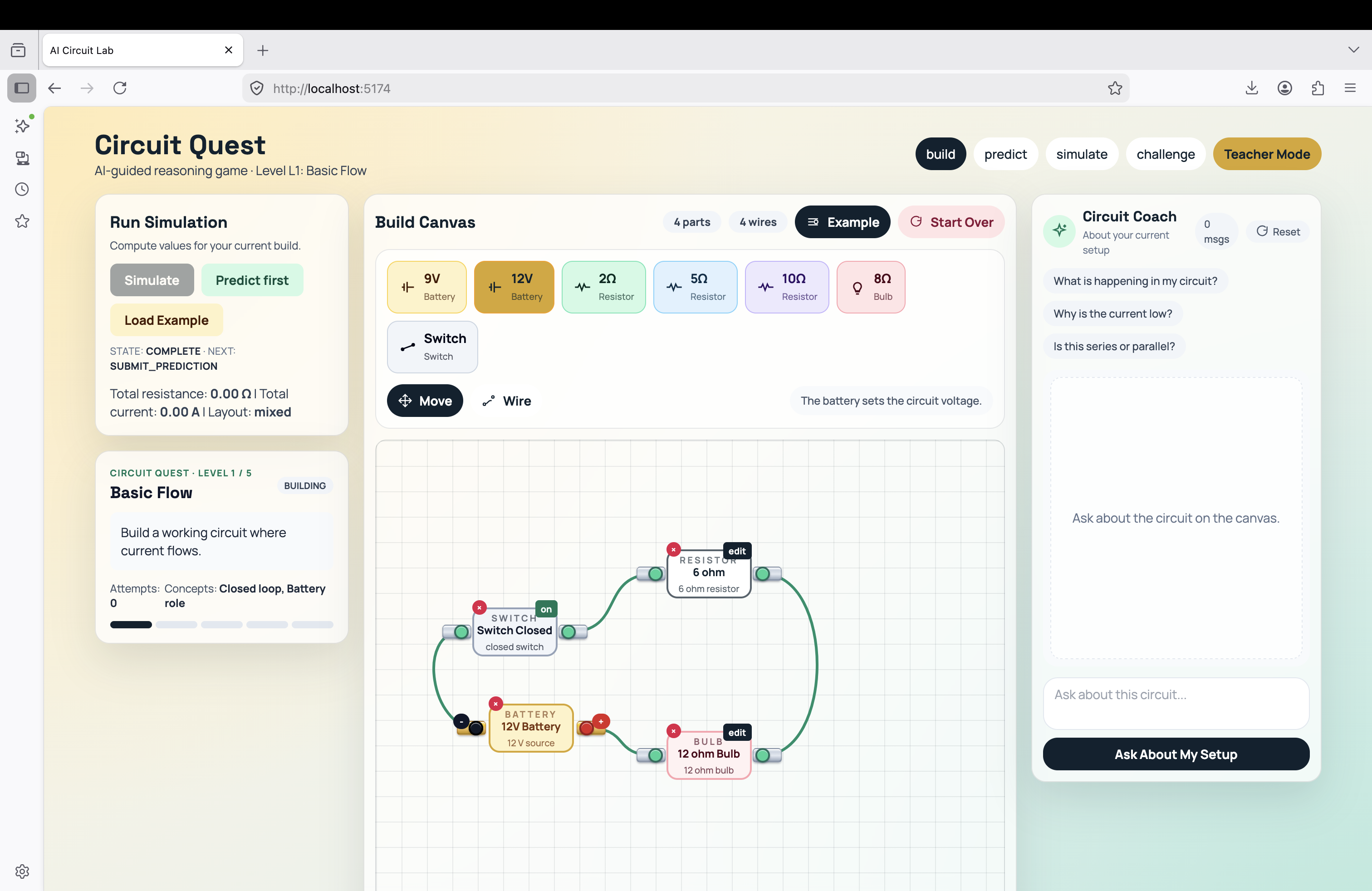
Circuit Quest: A Structured Interaction Environment for Reasoning in Electric Circuits
How can structured prediction and reflection loops reduce cognitive passivity when AI can generate instant answers?
Overview
As AI systems become better at generating immediate answers, learners can move through tasks without building the reasoning structures that support durable understanding.
Circuit Quest is an experimental cognitive interaction environment where participants construct circuits, commit predictions, simulate outcomes and explain mismatches between expected and observed behavior. AI is used as a reasoning mediator rather than an answer engine.
System
A structured interaction system combining a circuit canvas, real-time simulation and adaptive prompting tied to specific user actions.
- Canvas-based circuit builder (drag and drop)
- Real-time simulation engine
- Contextual AI prompting triggered by user actions
- Interaction logging for cognition analysis
Interaction Design
Every meaningful action is treated as a reasoning checkpoint. The core interaction loop is build → predict → simulate → compare → reflect.
- Add a battery → AI asks for a prediction.
- Add a resistor → AI probes the student's reasoning.
- Before simulation → a prediction is required.
- After simulation → the student compares prediction with the observed outcome.
The system does not provide direct answers before commitment. Explanations are generated only after users externalize their current model, which helps preserve cognitive effort.
Method
The system tracks prediction quality, response latency, misconception trajectories and revision behavior, alongside free-text reasoning. This enables analysis of AI-mediated thinking, not just answer correctness.
Results
- Increased engagement during circuit-building tasks.
- More iterative problem solving. Students try, observe and revise.
- Clear detection of misconceptions through the prediction-vs-actual gap.
Insight
Reasoning improves when people must commit before feedback. Requiring prediction surfaces latent mental models and creates productive tension for reflection and adaptation.
Future Work
- Controlled classroom study.
- Adaptive AI guidance based on misconception patterns.
- Teacher analytics dashboard.